
Laser Tube Cutting Thickness and Speed: Real Specs from the Factory
Laser tube cutting thickness and speed are the two numbers that decide whether a fiber laser tube cutter fits your work — and both are governed by the same triangle: laser power, material, and wall thickness. This guide sticks to what is actually published on our machine pages rather than brochure folklore: the cutting speeds the tube line is rated for (12 m/min on dedicated tube models, 80 m/min on the sheet-and-tube platform), the laser power range they ship with (1,000–3,000 W), the kerf width they hold (0.1–0.2 mm), why tube cutting differs from sheet, how to read a cutting chart, and the exact tube diameter and shape limits of every model in the range.
It is written from the factory floor rather than a showroom — for fabricators comparing machine classes or quoting a job. On the factory side, the thickness-speed pair is the first thing we test when a new tube batch arrives, because it sizes cycle time, gas consumption and downstream deburring all at once.
Cutting Speed: What the Machines Are Rated For
These are the published cutting-speed ratings from each model’s specification — quoted verbatim, with the spec’s own qualifier:
| Modèle | Round tube range | Published cutting speed |
| CTK-X2 | φ10–65 mm | 12 m/min, depending on material and thickness |
| CTK-X5 | φ10–115 mm | 12 m/min, depending on material and thickness |
| CTK-X5-LD | φ16–115 mm | 12 m/min; automatic feeding |
| CTK-X6-LD | φ40–115 mm | 12 m/min; heavy-pipe builds (compressor, A/C lines) |
| CTK-3015F / 3015FB | φ20–220 mm (diagonal ≤ 220 mm) | 80 m/min; combined sheet-and-tube platform |
Read the two numbers the way the spec intends. The 12 m/min class is the maximum rating for the dedicated tube line — reached on thin-wall sections under ideal conditions, and the specification itself qualifies it with “depending on the material and thickness.” The 80 m/min figure belongs to the sheet-and-tube platform and describes rapid traverse and thin-sheet work, not the average cycle speed on 4 mm tube. Quoting a job from the rating instead of the cutting chart is the most common estimating mistake we see — the sections below show how to get from the rating to a real cycle time.
Laser Power and Kerf: The Published Ranges
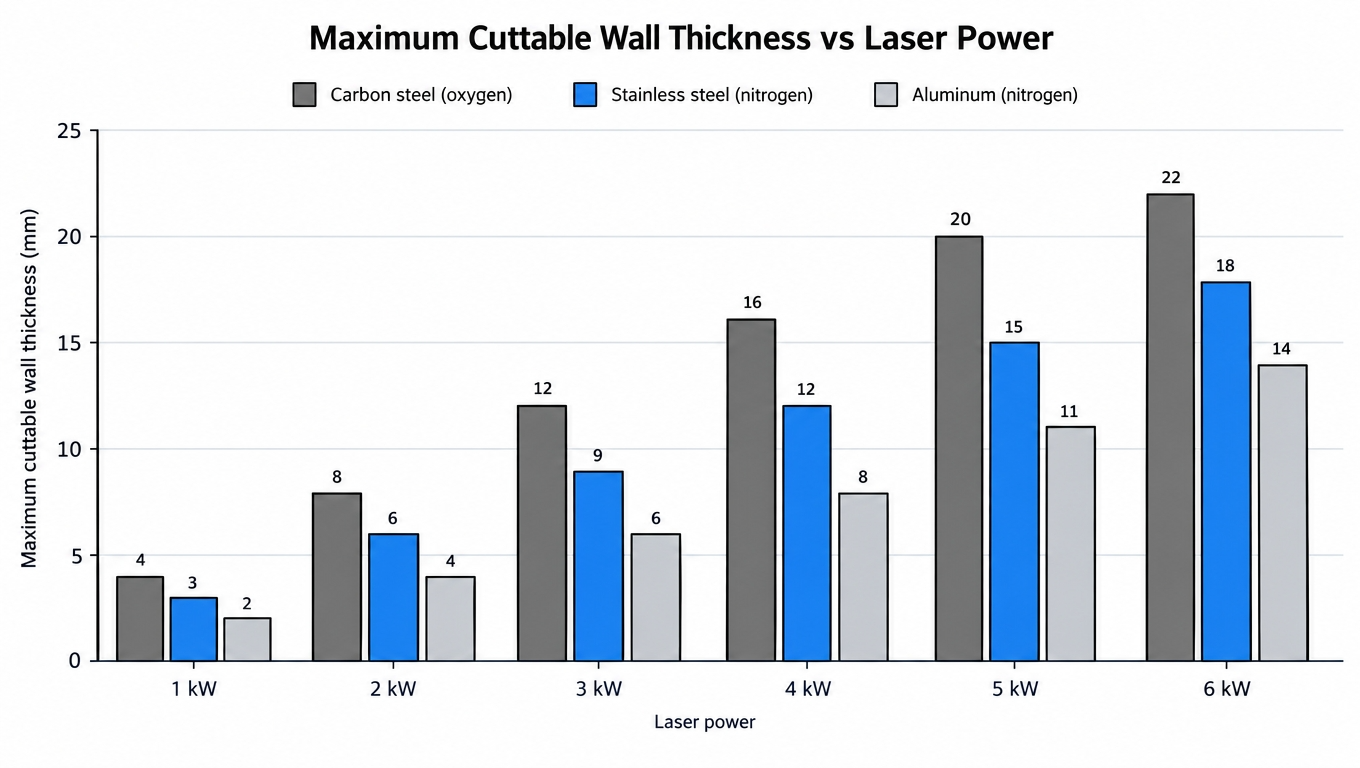
The tube line ships with fiber sources from 1,000 to 3,000 W (the CTK-C6 class), which covers the wall thicknesses most tube products actually use. On this power class, production work concentrates between roughly 1 and 6 mm wall — furniture, fitness equipment, handrails, exhaust, HVAC. The exact ceiling for a given power on a given material is a cutting-chart number, not a brochure number: every machine ships with charts per material and gas, and we confirm them with a sample cut of your tube before an order is finalized.
Kerf is published too: 0.1–0.2 mm with a 20 μm fiber (the CTK-C7-LN class). For design work this matters more than thickness: the kerf is the width of the channel the laser removes, so inside corners, slot widths and hole diameters must budget for it, and nesting software compensates the toolpath by its exact value on the day.
Why Tube Cutting Differs from Sheet
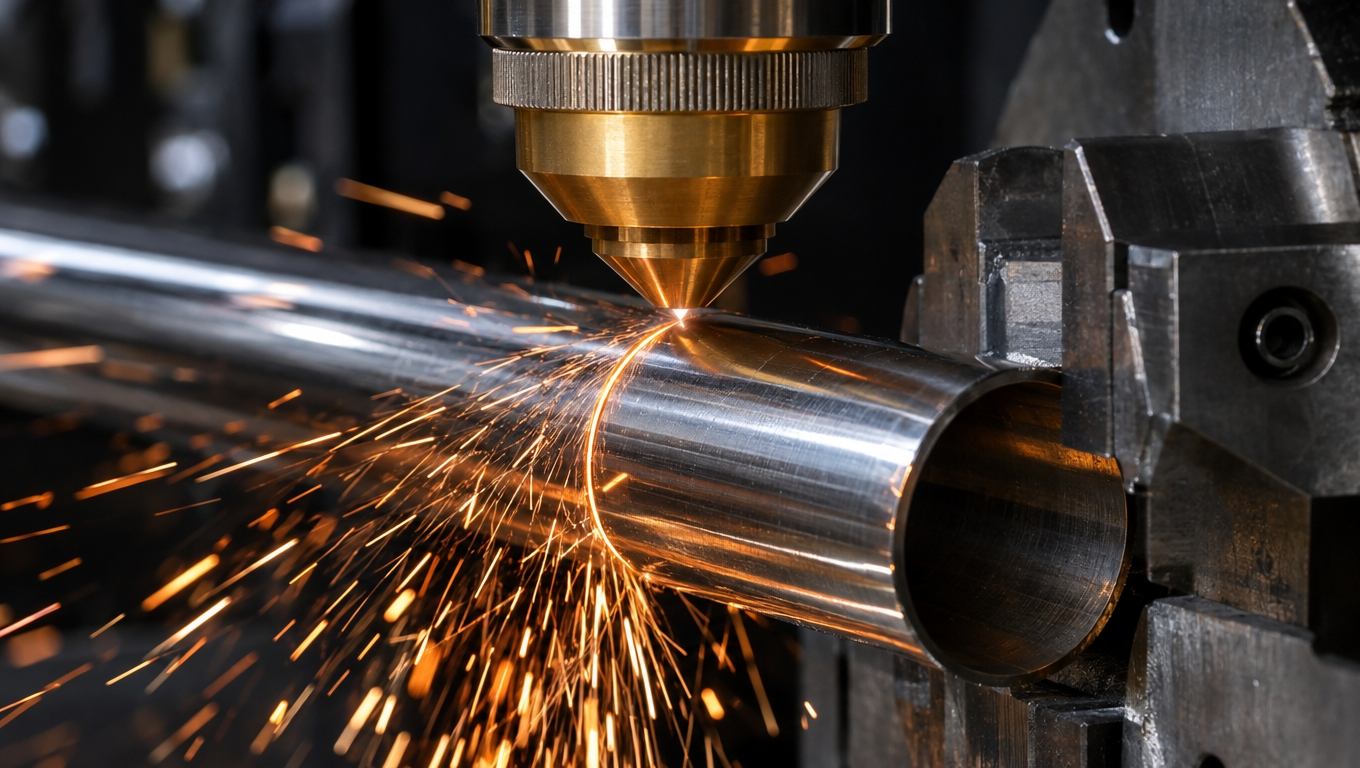
A cutting chart borrowed from sheet processing will lie to you on tube, for four reasons. Heat accumulates: the cut zone is inside a rotating part with less exposed surface to shed heat into, so speeds drop as the job continues and the support rests matter. The beam travels off-axis: on round tube the effective incidence angle changes with diameter, which is why φ16 mm tube and φ120 mm tube do not share parameters at the same wall. Clamping shifts the variables: jaw pressure, tailing support and the distance from chuck to cut all influence stability on long parts. Piercing happens on a curved surface — thin-wall tube dents if the pierce energy is wrong, and a dented tube is scrap. Machine classes handle this differently: full-stroke pneumatic chucks and automatic centering (as on our CTK-A6-E) hold thin-wall tube without marking, while high-speed models raise chuck rpm to keep thick sections stable.
How to Read a Cutting Chart
- Find your material row and wall column — charts are organized by material, assist gas and wall thickness; a 6 mm stainless number does not exist on a chart’s carbon steel page even if the machine can cut it.
- Separate cutting speed from piercing time — a chart speed of 10 m/min means nothing if the part has 40 pierces; cycle time is cut length ÷ speed plus pierce count × pierce time.
- Watch the corner and dwell values — corners slow the head while the laser stays on; on thin tube this is where burn-back starts.
- Check the gas pressure column — speed depends on pressure; running the chart speed at the wrong pressure trades edge quality for the number on the sheet.
- Treat chart + sample as the contract — before ordering, have the manufacturer cut your actual tube and time it; our tube laser cutting machine price guide lists what to send so the sample runs on the right configuration.
Diameter and Shape Limits: What Real Machines Carry
Thickness is only half of capability — the chucks and bed decide the tube sizes a machine can actually hold. These are the published limits of the range:
| Modèle | Round tube | Square / rectangular | Published capability |
| CTK-A12-E | φ8–120 mm | 10–80 mm; circumscribed ≤ φ120 mm | Lightweight auto-centering chuck for high-speed cutting |
| CTK-C12D-E | φ10–120 mm | 10×10–120×120 mm | Compact 9,000×1,500 mm footprint; 120 rpm chuck |
| CTK-A6-E | φ15–220 mm | Circumscribed < φ220 mm | Full-stroke pneumatic chuck for larger sections |
| CTK-C8-LN | φ20–360 mm | 20×20–250×250 mm; rect to 300×200 mm | Large-format tube; sealed front chuck, auto rear blow |
| CTK-C22-LN | φ12–220 mm | 12×12–160×160 mm | 7,000 mm manual / 5,800–6,500 mm automatic feed length |
| CTK-X15-E | φ16–80 mm | 16×16–60×60 mm | 150+ rpm chuck; automatic head-and-tail processing |
| CTK-P9-BD | Project range | Round, square, rect, special profiles | 45° bevel cutting; ±0.03 mm; 200 rpm double chuck |
Two selection notes. First, match the chuck to your thinnest tube, not your thickest — a jaw set that crushes 1 mm tube cannot be forgiven by a powerful source. Second, if your schedule mixes sheet and tube, a combined sheet and tube laser cutting machine covers both on one footprint. And if the profile you need is a slot rather than a cut — for racking and furniture frames — a dedicated pipe slotting machine does that job faster than a laser. For a structured way to turn these limits into a machine choice, see our engineer’s 9-step framework.
FAQ
What cutting speed do the tube laser machines actually deliver?
The dedicated tube line (CTK-X series) is rated at 12 m/min maximum, with the specification’s own qualifier: depending on the material and thickness. The combined sheet-and-tube platform (CTK-3015F/3015FB) is rated at 80 m/min on its best-case work. Real cycle time is always lower after piercing and corners — size estimates from the cutting chart, not the rating.
What thickness can a 1,000–3,000 W tube laser cut?
That power class covers the wall thicknesses most tube products use — production work concentrates between roughly 1 and 6 mm. The exact ceiling for each power on each material comes from the machine’s cutting chart; we confirm it with a sample cut of your actual tube before the order is finalized.
Why does kerf width matter for tube design?
The published kerf of 0.1–0.2 mm is the width of material the laser removes. Slot widths, inside corners and hole sizes must budget for it, and nesting software compensates the toolpath by the exact kerf value. Design that ignores kerf produces parts that need rework or do not fit.
Can one machine cut both sheet and tube?
Yes — the CTK-3015F/3015FB class carries φ20–220 mm tube (diagonal up to 220 mm) on the rotary axis plus a flat sheet bed, trading some tube-side automation for flexibility. They suit shops with mixed demand; dedicated tube machines win when tube is the main product.
The Short Version
Speed ratings are maxima: 12 m/min on the dedicated tube line, 80 m/min on the sheet-and-tube platform — and the spec itself says “depending on the material and thickness.” The 1,000–3,000 W source range covers the 1–6 mm walls where most tube work lives; exact ceilings are cutting-chart numbers confirmed by a sample cut. Kerf is 0.1–0.2 mm and belongs in your design math. Chuck and bed limits decide what the machine can hold — match them to your thinnest wall and longest tube. Then price the machine — our tube laser cutting machine price guide shows how that quote is built.
Have a tube schedule ready? Send it to Chittak and the export team will return cutting samples, cycle-time estimates and an itemized quote. Or browse the laser pipe cutting machine range to shortlist models first.
ARTICLES LES PLUS LUS
- Laser Tube Cutting Thickness and Speed: Real Specs from the Factory
- Tube Laser Cutting Machine Price: A Factory Guide to Cost and Quotes
- Comment découper des tubes en acier inoxydable à l'aide d'un laser à fibre optique
- Étude de cas : un fabricant de meubles allemand réduit son temps de préparation de 73% grâce à CHITTAK
- Comprendre la zone affectée par la chaleur (HAZ) dans la découpe laser au tube à fibre optique
