
Tube Laser Cutting Machine Parts: What Each Component Does
A tube laser cutting machine looks like a bed, a box and a glowing point of light, but everything it does comes down to four subsystems working in sync: the photonics that generate and focus the beam, the clamping that rotates the tube, the servo motion that positions the head, and the CNC that choreographs all of it. Buyers who can name each part and say what it does read specification sheets differently — they know which numbers matter, which are cosmetic, and which parts will need consumables budgets. This walkthrough covers the seven components that decide cutting performance, using published specifications from our own range where a number helps.
1. The Fiber Laser Source
The source is the machine’s engine. A fiber laser generates its beam inside doped fiber resonators pumped by diodes, and delivers it through a flexible fiber cable to the cutting head — no mirror alignment, no beam path to keep clean. Power classes for tube work typically run from 1 kW for light-gauge tube to 3 kW and above for heavy wall and stainless, and the power rating buys you two things: cutting speed at a given thickness, and headroom for piercing thick material. What power does not buy is quality by itself — that comes from the head, the chucks and the motion system working together. The thickness-and-speed relationship is tabulated in our laser tube cutting thickness and speed charts.
2. The Cutting Head and Nozzle
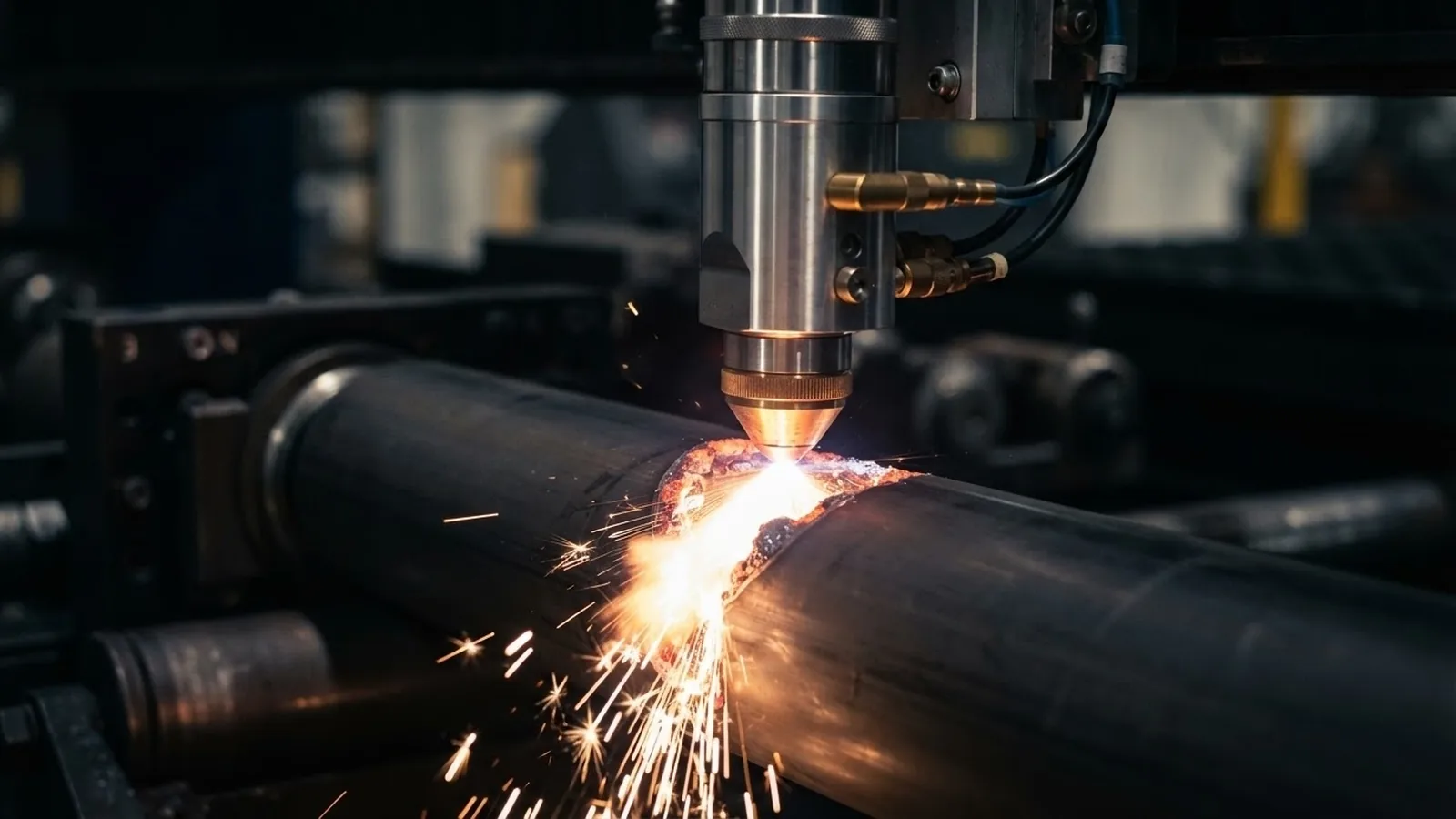
The head is where the beam meets the work. Inside it, collimating and focusing optics shape the raw beam into a working spot measured in fractions of a millimetre — on tube work the resulting kerf runs 0.1–0.2 mm, which is why laser-cut parts need almost no rework. Around the optics sit the consumables: a nozzle that shapes the assist-gas flow, a ceramic ring that insulates the sensor, and a protective window that keeps spatter off the focus lens. A capacitive sensor reads the exact standoff between nozzle and tube thousands of times a second and floats the head accordingly — essential on bent or slightly out-of-round tube, where the surface is never perfectly true. How much heat that process leaves in the metal, and how to minimize it, is covered in our guide to the heat-affected zone in fiber laser tube cutting.
3. Chucks and the Rotary Axis
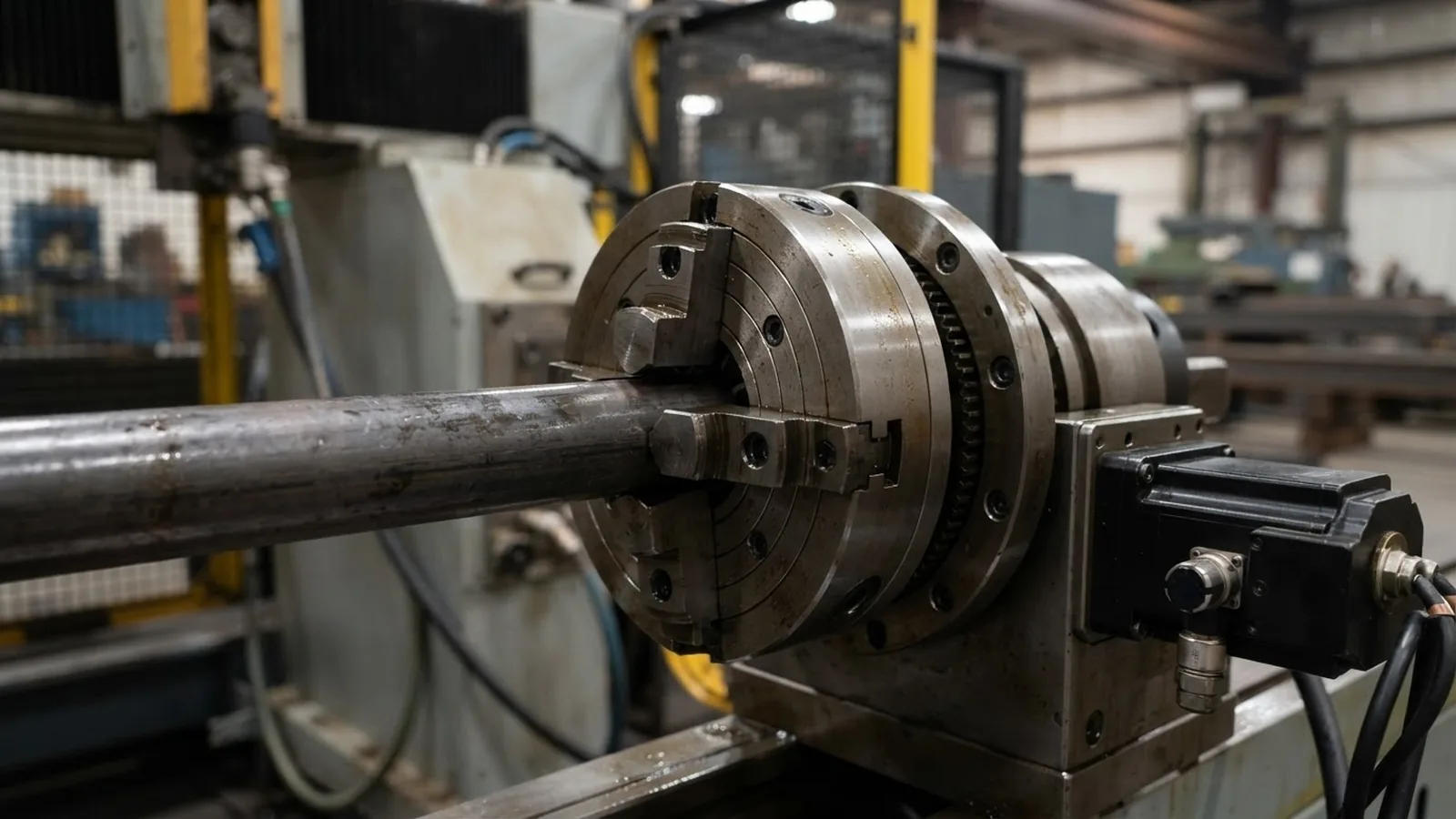
The chuck is the part that makes it a tube laser. A self-centering chuck grips the tube’s outside diameter and a rotary axis (the C-axis) turns it in perfect sync with the linear axes, so the cutting point stays under the head regardless of circumference — that synchronization is what lets one machine cut round, square and rectangular tube, C-channel and angle on the same job. Chuck count is the single biggest architecture decision: a single-chuck machine grips from one end, is affordable and simple, but leaves an uncut remnant where the jaws hold. A dual-chuck machine passes the tube from jaw to jaw, supporting and driving from both ends — it can cut right through the full length, which is the mechanical basis of zero-tail-material cutting. Our double-chuck bevel machine pushes the same architecture further, tilting the head to cut weld-ready 45° edges. If you are weighing configurations, “chuck for laser tube cutting machine” questions — jaw type, grip diameter range, rotation accuracy — belong on your supplier checklist before price does.
4. Servo Motion, Frame and Bed
Beneath the beam is ordinary heavy engineering: servo motors driving X and Y axes over racks and linear guides, a machined or cast bed that keeps its geometry for years, and a head carriage rigid enough to hold the nozzle-to-work standoff through acceleration. Tube machines add the rotary axis into the same interpolation loop, so a saddle cut is really a four-axis motion path. Frame quality shows up in the cuts you never think about: consistent pierce quality at the corners of a pattern, no chatter lines on long seams, and repeatability that survives a thousand-hour week.
5. Supports, Loading and Tail Handling
Long tubes are whippy. Roller supports and trolleys carry the workpiece along its length and keep thin-wall tube from vibrating under the cut, and they index automatically so a 6-metre bar presents itself accurately to the chuck. Loading is where labor goes: manual sling-and-drop works at low volume, while an automatic loading system feeds bundles one bar at a time and lets one operator mind two machines. The tail of the bar is money — machines engineered around short remnants keep more of every 6-metre length sellable, the economics of which we break down in the zero-tail link above.
6. CNC Controller and Software
The controller turns CAD into motion: it imports profiles, nests parts along the tube, sequences cuts to manage heat and remnant, and handles piercing parameters per feature. Modern tube controllers also handle rotation-aware nesting — rotating the tube to keep features on the best face and away from the clamp zones. Software capability decides how much of the machine’s mechanical potential you actually get; it is one of the nine evaluation steps in our engineer’s framework for choosing a tube laser cutting machine.
7. Chillers, Extraction and Safety
Three support systems keep the seven stars alive. A water chiller holds the source and optics at stable temperature — laser power and focus drift with temperature, so chiller sizing is a reliability item, not an accessory. Dust and fume extraction clears the smoke and slag the cut generates; tube cutting concentrates it inside the machine, so extraction design matters more than on flatbeds. And the cutting cell is a Class 1 laser enclosure: interlocked doors and protective window glass at the head, because the 1 µm wavelength that cuts steel also passes through the white of the eye.
Wear Parts: What You Will Actually Replace
Four items wear on a schedule, not a malfunction: nozzles, protective windows, ceramic rings and (eventually) focus lenses. None is expensive individually; together they are the machine’s ink cartridges. A two-shift shop budgets them monthly and keeps a drawer of each, and the maintenance habits that stretch their life are the same ones that protect the machine itself — our laser cutting machine maintenance guide covers the routine. When you compare quotes, ask what is on the wear-parts price list and how fast it ships: a cheap machine with a slow consumables pipeline is the expensive one.
From Parts to Purchase Decision
Every part above maps to a line on the quotation: source power to speed and thickness, chuck count to tail economics, motion and frame to the accuracy you can hold at speed, supports and loading to labor cost, software to usable output, wear parts to running cost. Price follows the same path — our tube laser cutting machine price guide shows where each subsystem moves the number. If one part of your application stresses one subsystem — thick wall, complex bevels, lights-out loading — For the market overview, start with our complete guide to tube laser cutting machines, or send the schedule to Chittak and we will match the architecture instead of the brochure.
FAQ
What is the difference between single-chuck and dual-chuck tube lasers?
A single-chuck machine grips one end: simpler and cheaper, but the jaws leave an uncut remnant and long tubes cantilever. A dual-chuck machine passes the tube from chuck to chuck, driving and supporting from both ends, cutting the full length with short remnants — the basis of zero-tail cutting and the better architecture for production work.
Does more laser power always cut faster?
Up to a point, yes — within each thickness there is a power band where speed climbs meaningfully, and beyond which extra power mainly helps piercing. The charts in our thickness-and-speed guide show where the curve flattens for carbon steel, stainless and aluminum.
Which parts of a tube laser wear out?
The scheduled wear parts are the nozzle, protective window, ceramic ring and focus lens — all small, all consumable, none fatal to the budget if you plan for them. The source, chucks and motion system are engineered for the machine’s life and are maintenance items, not consumables.
Can a tube laser cut square and rectangular tube?
Yes — the rotary axis keeps the cut point under the head as the profile turns, so round, square, rectangular, C-channel and angle all run on the same machine, with the nesting software rotating the profile to place features on the best faces.
ARTICLES LES PLUS LUS
- Tube Laser Cutting Machine Parts: What Each Component Does
- Cold Saw vs Band Saw: Which for Tube and Profile? A Factory Guide
- Laser Tube Cutting Thickness and Speed: Real Specs from the Factory
- Tube Laser Cutting Machine Price: A Factory Guide to Cost and Quotes
- Comment découper des tubes en acier inoxydable à l'aide d'un laser à fibre optique
