
Square & Rectangular Tube Laser Cutting: Parameters & Design Rules
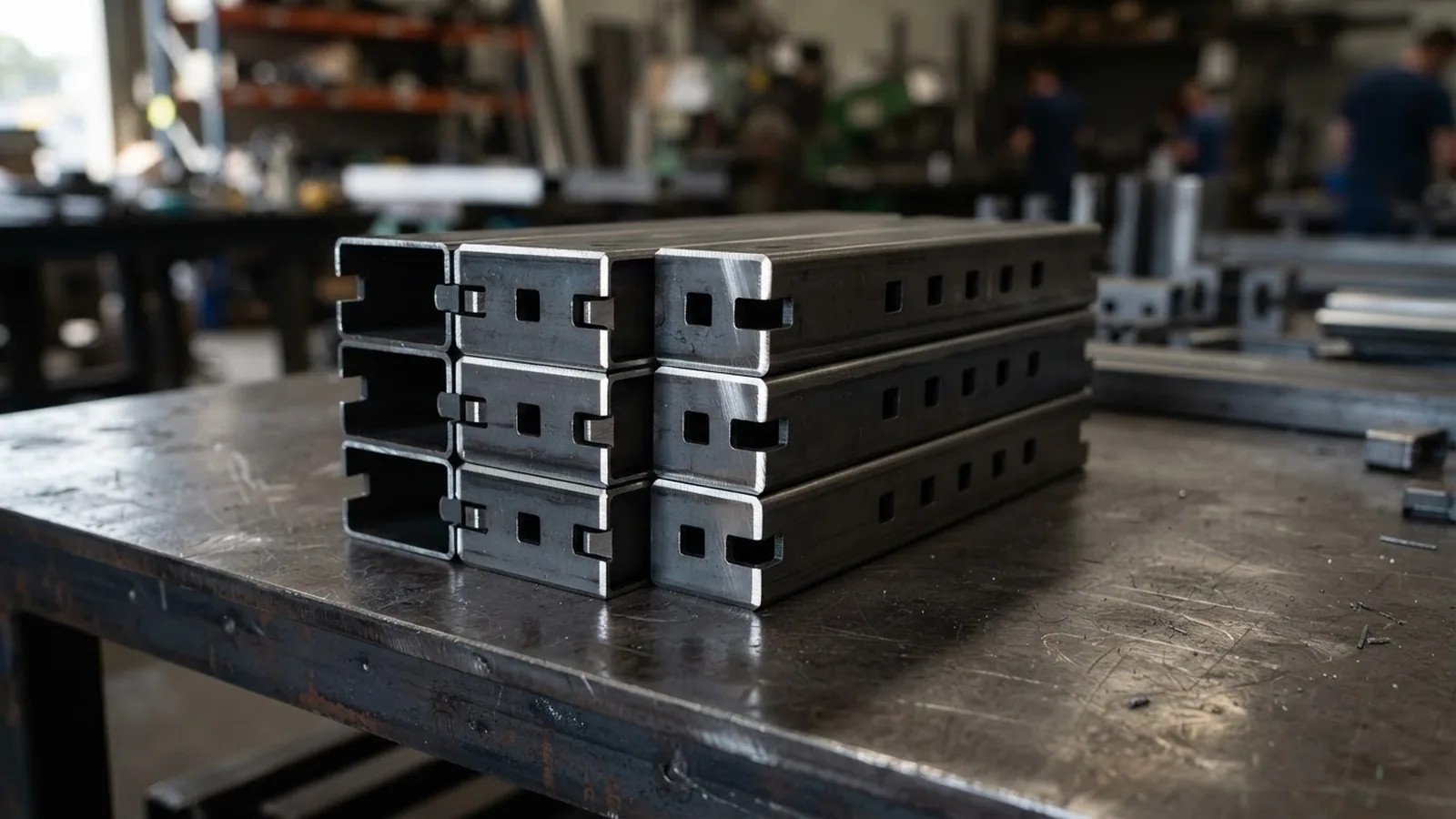
Square tube laser cutting and rectangular profile cutting account for most of the day-to-day work on a tube laser — furniture frames, racking, curtain-wall members, fitness equipment — yet the parameters that make it cut cleanly are different from round tube in ways spec sheets rarely explain. This guide covers what actually changes when the profile goes square: how the machine keeps the beam on the face, the diagonal rule that sets machine capacity, wall-thickness and speed parameters, and the part design rules that decide whether your frames come off the machine weld-ready — with published specifications from our own range used as the worked example.
What Changes When the Profile Goes Square
A round tube spins under the head, so the cutting point sees the same geometry all the way around. A square or rectangular profile rotates in steps relative to the beam path — the laser travels around corners — and three things follow from that. First, the machine must know the profile’s angular position at every instant: the rotary axis synchronizes with the linear axes so the focal point stays on the face even at the corners. Second, corners concentrate heat: the two faces meet at 90°, heat flows in from both, and cut quality there depends more on speed control than on raw power. Third, clamping behaves differently: flat faces mark more easily than round surfaces, which is why machines like the CTK-C12D publish adjustable clamping force — up to 120 rpm chuck speed with the force tunable so the jaw holds square tube without scarring it, assisted by anti-scratch feeding.
The Diagonal Rule: What Sets Machine Capacity
For round tube, capacity is the diameter range. For square and rectangular tube, the number that matters is the circumscribed circle — the diameter of the circle that contains the whole profile — and for rectangular sections, the diagonal. The profile must fit inside what the chuck can grip and swing clear of the machine. That is why our published specs state it exactly that way: the CTK-A6 takes rectangular and special-shaped tube up to a circumscribed circle of φ220 mm, the CTK-A12 up to φ120 mm, the C12D handles 10×10 to 120×120 mm with a diagonal under 120 mm, and the CTK-X15 covers 16×16 to 60×60 mm (diagonal under 85 mm). When you compare machines from any maker, convert your largest rectangular section to its diagonal and ask the vendor to state that number in writing — it is the single most common mismatch between quotation and workshop reality.
Wall Thickness and Cutting Parameters
Square-tube walls cut on the flat, so per-face behavior resembles flat-sheet cutting more than round-tube cutting: piercing is easier, and speeds on the face track the sheet numbers for the same material and thickness. The practical parameter set is still thickness-driven: a 1–1.5 kW source handles the wall thicknesses most furniture and racking profiles use, while 2–3 kW buys speed margin and heavy-wall headroom — the full thickness-and-speed tables by material are in our laser tube cutting charts. Two square-specific adjustments matter. Reduce speed through corners — the machine does this in the control, but nested designs with many corners lose you more time than the straight runs save, which is a design question, not a machine one. And on thin-wall square tube, watch distortion: the large flat faces act like heat collectors, so the cut sequence and pierce placement matter more than on round tube. The kerf itself stays the same 0.1–0.2 mm class as any fiber tube cut, which is what makes feature-dense square-tube parts economical in the first place.
Design Rules for Square and Rectangular Parts
- Keep features off the corners. Holes and slots that break into a corner edge cut on two faces at once — the worst thermal case. Leave the corner region solid or move the feature to a face.
- Respect the clamp zones. The chuck jaws grip a band at each end; features inside the grip band either wait for a reposition or never get cut. Design end features outside the jaw width where you can.
- Design the tail before the part. Machines with short-remnant engineering change what is economical: the C12D cuts to a ≥50 mm tail, the X15 to over 40 mm, and the H12 zero-tail-material line is built around not leaving sellable stock on the bar at all.
- If the part bends after cutting, keep cutouts out of bend zones. A slot 15 mm from a bend line distorts the bend; the process-chain rule is cut → bend → chamfer, and the cutting design respects the bending tool that follows it.
- Slot and hole sizing follows the kerf. A 0.1–0.2 mm kerf means internal features come out at size, but corner radii inside slots still need a minimum radius — design them at 0.5 mm and up and the parts stop needing hand work.
Published Capacity, Worked Example
| Modelo | Round tube | Square tube | Rectangular / shaped | Tail / note |
| CTK-A12 | φ8–120 mm | 10×10–80×80 mm | Circumscribed circle ≤ φ120 mm | Rigid bed, bus-system motion |
| CTK-C12D | φ10–120 mm | — | 10×10–120×120 mm, diagonal <120 mm | Tail ≥50 mm; 120 rpm adjustable clamping |
| CTK-A6 | φ15–220 mm | 10×10–80×80 mm | Circumscribed circle ≤ φ220 mm | Direct on-screen pattern drawing |
| CTK-X15 | φ16–80 mm | — | 16×16–60×60 mm, diagonal <85 mm | Tail >40 mm; 2 t auto-feed storage |
| CTK-H12 | — | — | Zero-tail-material line, 0.03 mm accuracy | Automatic feeding |
Every figure above is a published specification from the product page — the same numbers your quotation will carry. How a Chinese factory builds machines to these specs, and how to shortlist one, is in our top 10 manufacturers roundup; what each component contributes is in the parts guide.
Where Square and Rectangular Work Concentrates
The profile mix decides the machine more than the material does. Furniture and fitness programs run constant 25–80 mm square tube with feature-heavy faces — slot-and-tab construction that relies on the kerf accuracy. Racking and shelving add long rectangular members where the diagonal rule, not the square size, is the constraint. Curtain-wall and architectural work run large rectangular sections on the A6 class with surface-finish sensitivity that favors anti-scratch feeding and careful clamping. And stainless architectural tube brings its own parameter set — see cutting stainless steel tube with a fiber laser for the nitrogen and speed specifics.
Preguntas frecuentes
Can a fiber laser cut square tube?
Yes — it is the most common workload on tube lasers. The rotary axis keeps the focal point on the face through the corners, and flat faces actually pierce more easily than round ones. Capacity is set by the circumscribed circle or diagonal, not by the “tube diameter” number.
What size square tube can a tube laser cut?
It depends on the chuck class: our published range runs from 10×10 mm on the small end to 80×80 mm on the A12/A6 machines, with shaped and rectangular sections covered to a circumscribed circle of φ120–220 mm depending on model. Convert your largest section to its diagonal and check it against the machine’s published diagonal limit.
How close can I put a hole to the edge of a square tube?
Keep features out of the corner zones and the jaw-grip bands. As a design habit, start features at least one wall thickness plus a few millimetres from an edge, and never let a slot break into a corner — that is the one thermal case that costs quality on every machine class.
Does square tube cut slower than round?
On the flat faces, no — speeds track sheet-like behavior for the same wall. You lose time at corners (controlled speed-down) and on thin-wall sections where distortion control shapes the cut sequence. Design with fewer corners where you can, and the difference mostly disappears.
Check Your Profile Against a Machine
Send your largest rectangular section, its wall thickness and the feature style, and we will confirm which machine class carries it with margin — and what the parameters look like on your material. Contact Chittak for an itemized factory quote, or start from the price guide to see where the budget goes.
PUBLICACIONES MÁS POPULARES
- Square & Rectangular Tube Laser Cutting: Parameters & Design Rules
- Top 10 Tube Laser Cutting Machine Manufacturers in China (2026)
- Tube Laser Cutting Machine Parts: What Each Component Does
- Cold Saw vs Band Saw: Which for Tube and Profile? A Factory Guide
- Laser Tube Cutting Thickness and Speed: Real Specs from the Factory
