
Zero-Tailing Laser Tube Cutting: The Material-Savings Math
Every bar you cut ends the same way: the last part comes off, and a tail — the remnant between the final cut and the chuck grip zone — drops into the scrap bin. On paper it is offcut; over a year it is a line item. Zero-tailing laser tube cutting is the engineering answer to that line item: machine architecture (dual-chuck handoff, short-tail clamping, high-accuracy feeding) built so the remnant shrinks toward zero and the last part on the bar is as complete as the first. This article runs the actual arithmetic — where the tail comes from, how much it costs at three remnant lengths, and when the zero-tail premium pays back — using published specifications from our own range.
Where the Tail Comes From
A single-chuck tube laser grips the bar at one end. The chuck jaws need a grip band, the feed mechanism advances in finite steps, and the cut itself consumes a kerf. Add the safety margin the control keeps from the jaw, and every 6-meter bar keeps a remnant of 40–150 mm — steel you bought as tube and now sell as scrap. Machines reduce that remnant three ways: short-tail clamping (grip force and jaw geometry tuned so the cut can approach the chuck — our C12D cuts to a ≥50 mm tail; the X15 feeds to a >40 mm tail), dual-chuck handoff (the second chuck takes over so the cut passes the grip zone entirely), and feed accuracy — the H12 zero-tail-material line publishes 0.03 mm accuracy, because a handoff-and-cut sequence only works when both chucks agree on where the tube is.
The Material-Savings Math
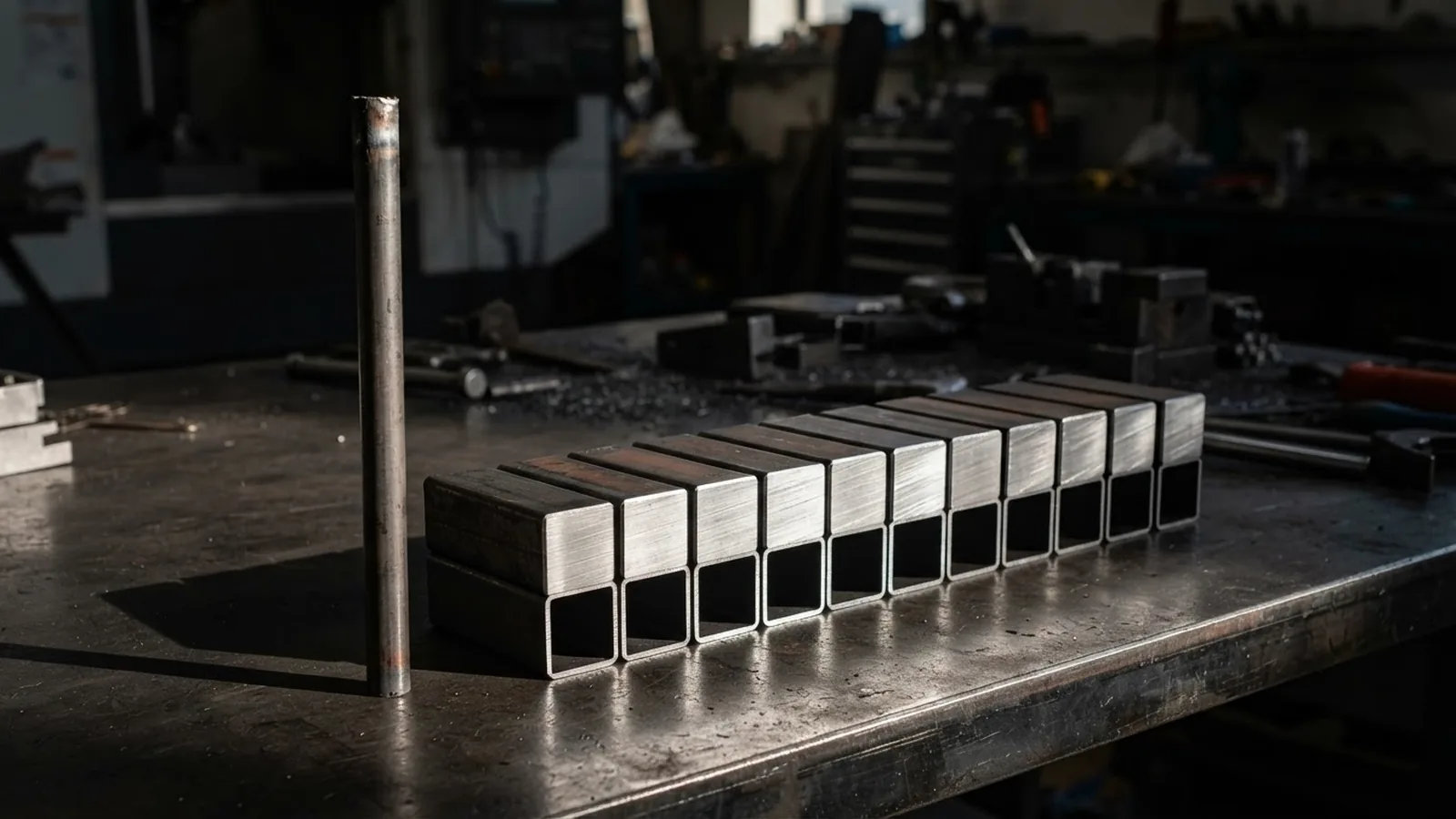
Take a shop cutting a 515 mm part from 6,000 mm bars of 50×50×2 mm square tube. Eleven parts consume 5,665 mm, leaving 335 mm minus grip and kerf — call it a realistic 100 mm remnant on a conventional single-chuck machine. The arithmetic at three remnant lengths, per 1,000 bars a month:
| Machine class | Remnant/bar | Waste per 1,000 bars | = full parts thrown away |
| Conventional (100 mm tail) | 100 mm | 100 m of tube | ~194 parts |
| Short-tail CNC (50 mm tail) | 50 mm | 50 m | ~97 parts |
| Zero-tail dual-chuck (0 mm) | ~0 mm | ~0 m | 0 |
Read the middle row as the underlined number: a short-tail CNC recovers half the waste immediately; the zero-tail architecture recovers all of it. At 100 m of 50×50×2 tube saved per 1,000 bars, you are keeping roughly 325 kg of steel a month (50×50×2 runs about 3.0 kg/m) out of the scrap discount and into finished product — multiplied by your material mix; stainless and aluminum multiply it further. The exact steel price is yours to insert; the lengths are machine physics, not estimates.
What Zero-Tailing Costs — and When It Pays
Honest framing: the dual-chuck zero-tail architecture carries a machine premium over a single-chuck design, and the payback depends on three variables only your shop knows — bars per month, tube value per meter, and part mix (short parts from long bars maximize remnant pain). The breakeven compresses fast when any of these is true: expensive material (stainless, aluminum), high part counts (the parts-thrown-away column above), or downstream processes that make near-net-length remnants useless anyway. Run your numbers against the price structure in our tube laser cutting machine price guide — and note the automation interaction: automatic loading feeds bars without an operator, but it is zero-tail cutting that decides whether the last meter of every bar becomes product or scrap.
Zero-Tail on the Chittak Line
Zero-tail is a family, not a single model. The CTK-H12 and its H12-LP and H12S-LP variants carry the dual-chuck zero-tail-material architecture with 0.03 mm accuracy and automatic feeding; the H9-LN/H9-LP extend it into the heavy-tube class. What the architecture means in practice: the second chuck catches the tube past the grip zone, the control hands off rotation mid-bar, and the cut sequence finishes the bar to its full length. Parts out of a zero-tail cell keep the same 0.1–0.2 mm kerf quality from first cut to last — the anatomy behind that is in our tube laser parts guide.
FAQ
What is zero tailing in laser tube cutting?
Cutting the bar so no unusable remnant is left: dual-chuck machines hand the tube over mid-bar so the cut passes the grip zone, and high-accuracy feeding lets the final part complete at the true end of the bar. The last part is as full as the first.
How much material does zero-tail cutting save?
The gap between your current remnant and zero — commonly 40–150 mm per bar on conventional machines. At 1,000 bars a month, a 100 mm tail is 100 meters of tube (about 325 kg in 50×50×2 steel) that zero-tail converts into finished parts.
Does zero-tail cutting work on square tube?
Yes — the handoff mechanism is profile-independent (the chucks carry whatever the jaws grip), though square and rectangular profiles add the usual corner-heat and clamping-force considerations covered in our square tube cutting guide.
Is a short-tail CNC enough, or do I need full zero-tail?
If your bars are cheap steel and your volume is modest, a short-tail machine (50 mm class) recovers half the waste for a smaller premium — the honest choice for many shops. Full zero-tail earns its premium on expensive material, high part counts, or lights-out automation where every meter is money.
Run Your Numbers With Us
Send your bar length, part lengths and monthly volume — we will return the remnant math for your exact mix against the H12 line, with an itemized quote including tooling. Contact Chittak, or see who else builds tube lasers in our 2026 manufacturer roundup.
POPULAR POSTS
- Zero-Tailing Laser Tube Cutting: The Material-Savings Math
- Square & Rectangular Tube Laser Cutting: Parameters & Design Rules
- Top 10 Tube Laser Cutting Machine Manufacturers in China (2026)
- Tube Laser Cutting Machine Parts: What Each Component Does
- Cold Saw vs Band Saw: Which for Tube and Profile? A Factory Guide
