Home > Blogs > Laser Tube Cutting Thickness and Speed: Charts by Power and Material
Laser Tube Cutting Thickness and Speed: Charts by Power and Material
By admin · Published
Laser tube cutting thickness and speed are the two numbers that decide whether a fiber laser tube cutter fits your work — and both are governed by the same triangle: laser power, material, and wall thickness. A 1.5 kW source that breezes through 1 mm stainless at 20 m/min will grind through 10 mm carbon steel at half a metre a minute, if it can bevel-cut it at all. This guide gives the maximum-thickness table by power and material, the speed charts for carbon steel, stainless and aluminum, the tube-specific factors that bend those numbers (heat accumulation, clamping, support), how to read a manufacturer’s cutting chart, and the diameter and shape limits of real machines, using our own published model data.It is written from the factory floor rather than a showroom — for fabricators comparing machine classes or quoting a job. On the factory side, the thickness-speed pair is the first thing we test when a new tube batch arrives, because it sizes cycle time, gas consumption and downstream deburring all at once.A cutting chart is a set of parameters, not a promise: speed, pierce time, corner speed and gas pressure move together.
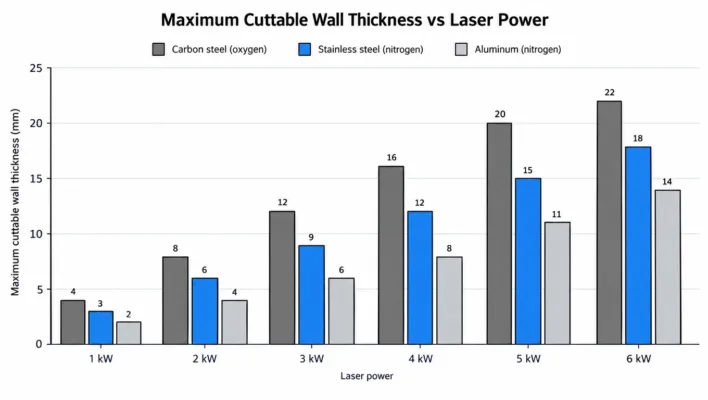
Maximum Wall Thickness by Laser Power
The table below shows the thickness ceilings where fiber laser tube cutting remains a production process rather than an experiment. They are typical ranges for current fiber sources — the cutting chart shipped with your machine governs:
Laser power
Carbon steel (O²)
Stainless steel (N²)
Aluminum (N²)
1 kW
≈ 10 mm
≈ 5 mm
≈ 4 mm
1.5 kW
≈ 12 mm
≈ 7 mm
≈ 5 mm
2 kW
≈ 16 mm
≈ 8 mm
≈ 6 mm
3 kW
≈ 20 mm
≈ 12 mm
≈ 10 mm
6 kW
≈ 25 mm
≈ 16 mm
≈ 14 mm
Two reading notes. First, these are maximum values: the edge of the process window, where cut quality depends on perfect setup and the right consumptionables. Production cutting lives one or two wall sizes below each ceiling. Second, ceiling ≠ sweet spot — most tube work (furniture, fitness equipment, exhaust, handrails) sits between 1 and 6 mm, which is why 1.5–3 kW sources dominate the tube segment. What the extra wattage buys is speed at mid thickness, covered next.
Cutting Speed Charts
Speeds below are continuous-cut values for straight lines on tube — typical fiber-source ranges, confirm against your machine’s cutting chart. Corner moves, piercing and pierce-then-continue strategies reduce the effective average.Carbon steel, oxygen assist (the economy route: fast, oxidized edge):
Wall
1 kW
2 kW
3 kW
1 mm
8–10 m/min
12–15 m/min
15–18 m/min
3 mm
3.5–4.5 m/min
6–7.5 m/min
8–10 m/min
6 mm
1.1–1.4 m/min
1.8–2.2 m/min
2.5–3 m/min
10 mm
—
1.0–1.2 m/min
1.5–1.8 m/min
Stainless steel, nitrogen assist (the clean route: oxide-free edge ready for welding or finishing):
Wall
1 kW
2 kW
3 kW
1 mm
18–22 m/min
28–35 m/min
35–45 m/min
3 mm
4.5–5.5 m/min
9–11 m/min
12–15 m/min
6 mm
—
3.5–4.5 m/min
6–7 m/min
10 mm
—
—
2.5–3.2 m/min
Aluminum, nitrogen assist (reflective, so the workable window starts around 2 kW):
Wall
2 kW
3 kW
2 mm
6–8 m/min
8–11 m/min
4 mm
3–4 m/min
4.5–6 m/min
6 mm
2–2.8 m/min
3.5–4.5 m/min
The gas decision is a cost decision: oxygen costs a fraction of nitrogen and cuts thick carbon steel faster, but leaves an oxidized edge that needs finishing; nitrogen costs more per hour and returns a weld-ready edge. Which route wins depends on what happens to the tube after the cut — for stainless work destined for welding or polishing, see our guide to cutting stainless steel tubes with a fiber laser.Nitrogen returns a weld-ready edge; oxygen cuts carbon steel faster and cheaper but leaves an oxidized surface.
Why Tube Cutting Differs from Sheet
A cutting chart borrowed from sheet processing will lie to you on tube, for four reasons. Heat accumulates: the cut zone is inside a rotating part with less exposed surface to shed heat into, so speeds drop as the job continues and the support rests matter. The beam travels off-axis: on round tube the effective incidence angle changes with diameter, which is why φ16 mm tube and φ120 mm tube do not share parameters at the same wall. Clamping shifts the variables: jaw pressure, tailing support and the distance from chuck to cut all influence stability on long parts. Piercing happens on a curved surface — thin-wall tube dents if the pierce energy is wrong, and a dented tube is scrap. Machine classes handle this differently: full-stroke pneumatic chucks and automatic centering (as on our CTK-A6-E) hold thin-wall tube without marking, while high-speed models raise chuck rpm to keep thick sections stable.
How to Read a Cutting Chart
Find your material row and wall column — charts are organized by material, assist gas and wall thickness; a 6 mm stainless number does not exist on a chart’s carbon steel page even if the machine can cut it.
Separate cutting speed from piercing time — a chart speed of 10 m/min means nothing if the part has 40 pierces; cycle time is cut length ÷ speed plus pierce count × pierce time.
Watch the corner and dwell values — corners slow the head while the laser stays on; on thin tube this is where burn-back starts.
Check the gas pressure column — speed depends on pressure; running the chart speed at the wrong pressure trades edge quality for the number on the sheet.
Treat chart + sample as the contract — before ordering, have the manufacturer cut your actual tube and time it; our tube laser cutting machine price guide lists what to send so the sample runs on the right configuration.
Maximum thickness is the edge of the process window — production cutting lives one or two wall sizes below it.A cutting chart is a set of parameters, not a promise: speed, pierce time, corner speed and gas pressure move together.
Diameter and Shape Limits: What Real Machines Carry
Thickness is only half of capability — the chucks and bed decide the tube sizes a machine can actually hold. These are the published limits of our laser tube models:
Two selection notes. First, match the chuck to your thinnest tube, not your thickest — a jaw set that crushes 1 mm tube cannot be forgiven by a powerful source. Second, if your schedule mixes sheet and tube, a combined sheet and tube laser cutting machine covers both on one footprint. And if the profile you need is a slot rather than a cut — for racking and furniture frames — a dedicated pipe slotting machine does that job faster than a laser. For a structured way to turn these limits into a machine choice, see our engineer’s 9-step framework.
FAQ
What thickness can a 1.5 kW fiber laser cut on tube?
Typical ceilings: about 12 mm carbon steel with oxygen, 7 mm stainless with nitrogen and 5 mm aluminum with nitrogen. Production work should sit one or two wall sizes below the ceiling — a 1.5 kW source is at its best on 1–6 mm walls, where most tube applications live.
Why does nitrogen cost more than oxygen for cutting?
Nitrogen cuts by blowing molten metal out with high pressure and volume, so consumption per hour is far higher; it is also slower on thick carbon steel. What it buys is an oxide-free, weld-ready edge. Oxygen is cheap and fast on carbon steel but leaves an oxidized edge that needs finishing.
Does tube cutting speed differ from sheet speed at the same thickness?
Usually yes — tube runs slower. Heat accumulates in a rotating part, the beam meets the material at changing incidence angles, and clamping geometry adds variables. Expect the tube number to be a discount on the sheet number, and confirm with a sample cut on your actual tube.
Can one machine cut both sheet and tube?
Yes — combined sheet-and-tube models swap between a flat bed and rotary tube support, trading some tube-side automation for flexibility. They suit shops with mixed demand; dedicated tube machines win when tube is the main product.
The Short Version
Power sets the thickness ceiling: roughly 10–25 mm carbon steel, 5–16 mm stainless and 4–14 mm aluminum from 1 to 6 kW — and production lives below the ceiling. Speed is a chart, not a number: material, gas and wall thickness decide it, and tube-specific heat and clamping effects discount sheet values. Chucks and bed decide what the machine can hold — match them to your thinnest wall and longest tube. Confirm every figure with a sample cut of your own material, then price the machine — our tube laser cutting machine price guide shows how that quote is built.Have a tube schedule ready? Send it to Chittak and the export team will return cutting samples, cycle-time estimates and an itemized quote. Or browse the laser pipe cutting machine range to shortlist models first.